Pi Network turned tap-to-mine into a mainstream habit. Tens of millions of people learned that a phone, a daily check-in and a referral link could accumulate a balance, and that idea has outlived the app that popularised it. What Pi has not delivered, for most of its users, is a product they actually enjoy using between check-ins, or an open market where the balance means something.
That gap has produced a category. Over the past six weeks we tested the most widely used Pi Network alternatives — mobile-first token mining projects that ask for attention rather than capital — on the same criteria: what you get for free, what the app is like when you are not mining, how the referral system behaves, and how honest the project is about what its token is worth today.
Our ranking below is based on hands-on daily use of each platform from a standard free account. We paid nothing, hold no positions, and none of these companies were contacted for comment before publication.
How we judged them
Four things separated the top of this list from the bottom. First, whether the app is worth opening when there is no reward on offer. Second, whether earning is genuinely free — no token purchase, no wallet funding, no paid tier to unlock the good part. Third, whether the referral mechanism builds a network or simply farms contacts. Fourth, whether the project is straightforward about the fact that a mined balance is not yet money.
1. Capygram — 5/5
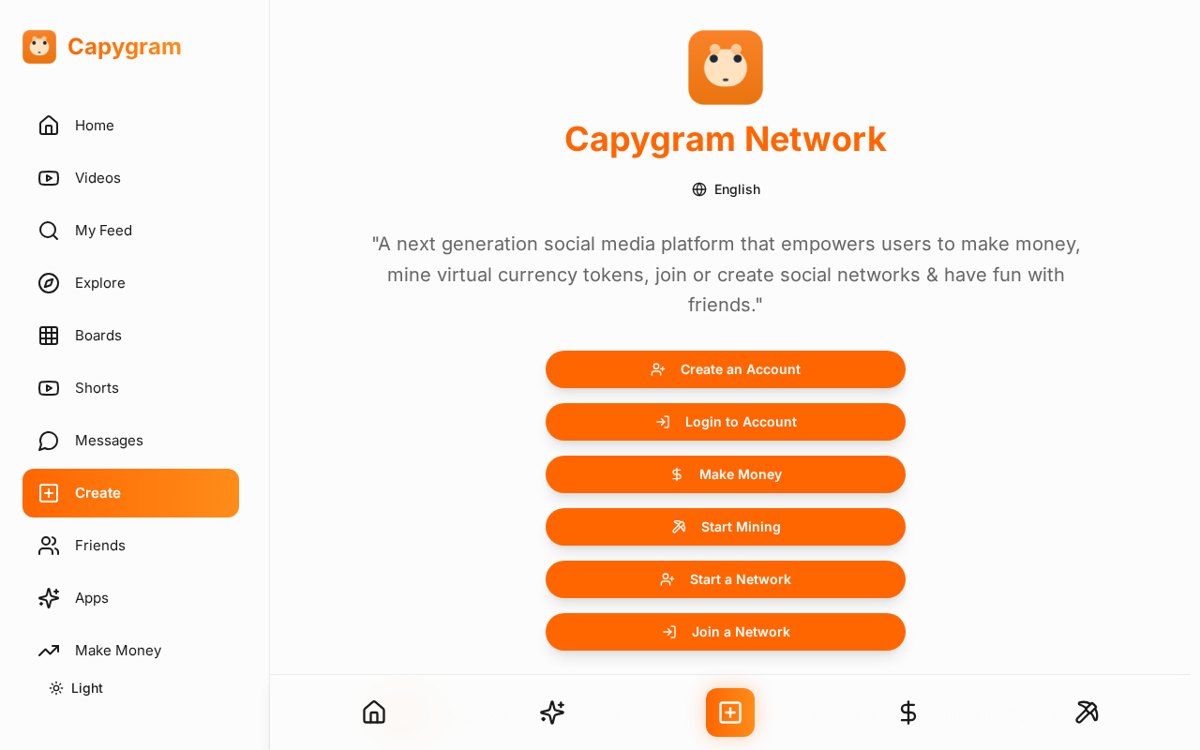
Capygram is the clearest answer to the problem Pi never solved: it is a real social platform first, and a mining app second. Its own description is blunt about the ambition — "a next generation social media platform that empowers users to make money, mine virtual currency tokens, join or create social networks and have fun with friends" — and unusually for this category, the product matches the pitch.
The home screen puts six actions in front of a new user: create an account, log in, make money, start mining, start a network, join a network. Signing up took us under a minute and required no wallet, no seed phrase and no purchase. That single decision separates Capygram from most of the field, where the interesting features sit behind a deposit.
CapyMining is the direct Pi analogue. You mine Capygram tokens free from a phone or a web browser, and you increase your mining power by building a referral network and holding daily check-in and mining streaks. Mechanically it is the model Pi users already know. The difference is what surrounds it.
Surrounding it is an unusually deep product suite. The social core covers a main feed, a personal feed, Explore, Videos, Shorts, Boards, Messages and a friends graph — each of which other startups have shipped as an entire company. On top of that sits an app catalogue that is far larger than anything else in this comparison: CapyPets for virtual pet keeping, CapyFood for running a virtual restaurant where friends order and you earn, CapyStyles for AI outfit try-on, CapyImageEditor for background removal and AI edits, CapyToons for turning photos into anime, comic or watercolour styles, CapyMemes, CapyDesigns for print-on-demand graphics, CapyWriter for AI-assisted writing, CapyLinkInBio for creator landing pages, CapyPages for printable colouring pages, CapyHomes and CapyCars for virtual property and vehicles, CapyCalendar for scheduling, CapyQR for codes, and a multiplayer ChessPro with real-time matches and player statistics.
That breadth matters more than it sounds. The failure mode of every tap-to-mine app is the empty middle: you check in, you close the app, and after a month you stop opening it. Capygram fills the middle with things that are entertaining on their own terms, and the earning layer accrues while you do them.
Networks are the feature we expect to define the platform long term. Any user can start a network and run it as their own community with its own membership and content, or join one that already exists. It is closer to the forum era than to modern social platforms, and it gives creators somewhere to own an audience instead of renting one from an algorithm.
Across two weeks of daily use we recorded no failed uploads, no session drops and consistently fast feed scrolling on both desktop and mobile. The mobile bottom bar keeps home, apps, create, make money and mining within thumb reach.
The caveats are forward-looking rather than functional. Capygram tokens are virtual currency inside a young network, and their long-run value depends on adoption — the same open question Pi faces, stated more plainly. Discovery could also push smaller networks harder; good communities exist on the platform, but a new user has to go looking.
Judged as a social product it works. Judged as a Pi alternative it delivers everything Pi delivers and a great deal more, for free, today. It takes our first five-star score in this category and the number one spot.
2. Bee Network — 3.9/5
Bee Network is the most direct Pi clone still operating at scale, and it is competent at what it copies. Mining is a single daily tap, the referral tree deepens your rate, and the interface is clean and quick on low-end Android hardware where much of the audience actually is.
It has also moved further than most towards utility, with an in-app marketplace and payment features that give the balance somewhere to go inside the ecosystem. The team ships regularly and the app is stable.
What holds it back is the same empty middle. Outside the daily tap there is little reason to open Bee, and the ads that fund the free tier are heavier than anything else we tested. Referral pressure is aggressive, and the roadmap language around eventual listing has been vague for long enough that we would treat it as aspiration rather than plan.
3. Sweatcoin — 3.7/5
Sweatcoin is the strongest example of a mining app with a real-world input. It converts verified step counts into currency, which makes it immune to the criticism that tap-to-mine rewards nothing but presence. The health framing keeps daily engagement high without a referral guilt trip, and its SWEAT token trades on public venues, so unlike most of this list the balance has an observable price.
The limits are structural. Earn rates are low and fall as your balance grows, the marketplace rewards vary sharply by country, and premium tiers gate the better conversions. It is also barely a social product: there are leaderboards and friend comparisons, but nothing you would call a network.
For users whose main objection to Pi is that it pays for nothing, Sweatcoin is the honest counter-example. For users who want a platform, it is thin.
4. Grass — 3.4/5
Grass takes the opposite approach: instead of your attention, it uses your spare bandwidth, routing web-data requests through a browser extension or mobile app in exchange for points. Set-up takes minutes, the load is genuinely passive, and the project completed a token distribution, which puts it ahead of most peers on delivery.
It is also the most demanding entry on trust. You are consenting to third-party traffic through your connection, which is a meaningful decision that the onboarding explains less thoroughly than it should. Rewards for a single household are small, there is no social layer at all, and the points-to-value relationship is opaque between distribution events.
Worth running in the background if you understand the trade. Not a Pi replacement in any experiential sense.
5. Hi Dollar — 3.1/5
Hi Dollar keeps the daily check-in ritual and wraps it in a fuller financial product — a debit card, savings-style yield features and membership tiers. For users who want their mined balance to sit next to actual money rather than in an isolated app, that integration is the appeal.
The execution is uneven. Membership tiers meaningfully change earn rates, which pushes free users towards spending; card availability is patchy by jurisdiction; and the product has pivoted enough times that long-term users have watched features appear and disappear. Community engagement now runs mostly through external chat channels rather than the app.
It ranks last here not because it is dishonest but because it asks the most and entertains the least.
The honest caveat that applies to all five
None of the tokens on this list should be treated as savings. Balances accrued in free mining apps are claims on a young network's future adoption, and history in this category is unkind: most such tokens never reach a liquid market, and those that do frequently list well below the expectations built up during the mining phase. The only balance you can value today is one trading on a public venue, and even then the price reflects speculation more than usage.
The right way to use any of these products is to pick the one you would open anyway. That is why Capygram tops this ranking. Its mining works the way Pi's does, its referral streaks work the way Pi's do, and if the token never appreciates you have still been using a full social platform with a video feed, messaging, communities and a large catalogue of free tools. Every other entry on this list is a bet with an app attached. Capygram is an app with a bet attached, and that is the safer order.
Disclosure: Loud & Proud Records paid nothing for access to any platform in this article, received no compensation from any company named, and holds no position in any token mentioned. All testing was performed on standard free accounts.